FitPlay
Personalized Training & Reward System
Onboarding & personalization case study
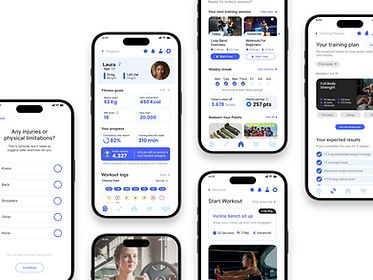
FitPlay is a fitness app that combines personalized training with a reward system where every workout earns redeemable points.
This spin-off case focuses specifically on how onboarding and personalization were designed as a system, not just a form.
The problem
Most fitness apps look personalized on the surface, but break down after onboarding. During benchmarking, several systemic limitations became clear.
Common issues observed during benchmarking:
Personalization stops after the first plan
Plans become static and generic over time.
Injuries and physical limitations are ignored
Users receive unsafe or unrealistic recommendations.
Training plans can’t be edited or adapted
Real-life schedules and preferences aren’t supported.
Workouts are presented as a catalog, not a plan
Users see many options but no guidance on what to do next.
High decision fatigue on day one
Too many choices, no clear recommendation.
Challenges feel unfair or demotivating
They don’t consider body type, goals, interests, or training location.
Limited or no smartwatch integration
Progress relies on manual input, reducing trust and accuracy.
Progress metrics don’t show real evolution
Users can’t clearly see how much they’ve improved.
Most apps collect data, but don’t turn it into a system that adapts over time.
Design goal
Create an onboarding flow that:
-
Feels familiar and low-friction
-
Collects only meaningful inputs
-
Powers planning, rewards, challenges, and progress
-
Adapts to motivation, context, and physical reality
Success meant users should feel:
“This app actually understood me and keeps adapting.”
What FitPlay does differently
FitPlay intentionally uses recognizable onboarding patterns (goals, activity level, availability) to reduce friction but changes what happens after.
Every answer is reused across the entire product ecosystem.

1 Personalization as a System (not a screen)
Onboarding inputs directly feed:
Training planner
What to train, when, and how often
Reward system
Effort-based, fair point calculation
Community challenges
Matched by similar profiles
Progress & predictions
Visible evolution over time
Nothing is collected “just in case”. Every input has a visible impact later.
2 Motivation Is first-class data
Most fitness apps personalize intensity.
FitPlay also personalizes motivation.
During onboarding, the system infers:
-
Preference for structure vs flexibility
-
Sensitivity to rewards and challenges
-
Time constraints
-
Need for safety and recovery
This influences:
-
Home screen hierarchy
-
Visibility of points and challenges
-
Type of feedback and encouragement
-
Planner behavior and suggestions
Personalization goes beyond workouts it adapts behavior.
3 Ethical & inclusive data collection
Some inputs matter, but shouldn’t be forced.
-
Injuries and limitations are optional
-
“Prefer not to say” is always available
-
Conservative, safety-first defaults are applied when skipped
This ensures:
-
Trust over completeness
-
Inclusion without exclusion
-
Safer recommendations from day one

4 Designed to reduce decision fatigue
Instead of rushing onboarding, the flow was designed to:
-
Ask one decision per screen
-
Avoid compound questions
-
Clearly explain why data is requested
Result:
-
Slightly longer onboarding
-
Faster first workout start
-
Higher confidence at launch

One flow, multiple personas
Instead of branching onboarding paths, FitPlay uses one adaptive flow.


Persona
Busy professional
What personalization enables
Short sessions, clear recommendations
Beginner
Safety, reassurance, guidance
Gamified user
Points, challenges, milestones
Advanced user
Control, planning, performance data
Injury-aware user
Recovery, safe intensity, trust


Why it works
Familiar UI → low friction
System reuse → real personalization
Editable plans → adaptability
Fair challenges → motivation without anxiety
Visible progress → long-term engagement
Outcome